andie, she/her, 26, united states. this blog is full of Tolkien. also other art, photos, fandoms, and big-eyes-emoji stuff, but mostly Tolkien. i tag! my girlfriend is bright ivanaskye, who is a lot, but not too much
An assignment I actually wrote on the board this week:
In groups, write 2 sentences (in Latin) using only the
vocabulary in your textbook. Make sure to include:
1 irregular verb
1 imperfect verb
5 cases
BEES?
I’ll elaborate in a minute, but I need to stop laughing
first.
So I’d originally planned on a 20-minute grammar lesson,
followed by a handout to be finished in pairs, but I’d made the mistake of telling
this class about Latin Day in April and how we were encouraging them to come to
school in costume. All they wanted to do was talk about costume opportunities
(and since I would like to keep my job, I had to explain why staging Caesar’s assassination
in the middle of the lunchroom would be a Bad Idea), so I shifted gears and decided
to channel that creative/social energy into a different assignment.
After lugging them through a condensed version of the
grammar lesson on irregular verbs in the imperfect tense, I split them into
groups and pulled an assignment out of the air.
The requirements:
Write two sentences in Latin
Use ONLY vocabulary from the textbook
Include at least ONE irregular verb
Include at least ONE verb in the imperfect tense
Include 5 (out of 6, including the vocative)
cases
The goal:
To write them on the board for their ‘rival’
groups to translate
They are a competitive bunch, so I knew this would be enough
to encourage them to go All Out. But then one student raised her hand.
“Can our sentences be about bees?” she asked.
Bees. I swear this class has a thing with Bees. I hesitated.
“There are no bees in your textbook.”
“Yes, but you taught us that word.”
I had, back when this same student had asked me how to say “the
bees are suffering” for a kahoot she was writing. Granted, this same student is
planning on coming in on Latin Day dressed as Caligula’s horse, so none of this
surprises me.
I opened it up to the other ‘groups’. “What do you think?” I
asked. “Should we let them write about bees?”
“No,” said one student with a heavy sort of solemnity, looking
me dead in the eye. “We should all be required
to write about bees.”
As the rest of the class eagerly cheered and nodded in
agreement, three things occurred to me.
The word for bee, “apis”, is a 3rd-declension
i-stem noun, which they could use more practice on.
They’re going to want to describe the bees,
which means they will likely also be practicing noun-adjective agreement with a
3rd-declension i-stem noun, which they could also use more practice
on.
This could be flipping hilarious.
And so I added “BEES?” to the list.
The results:
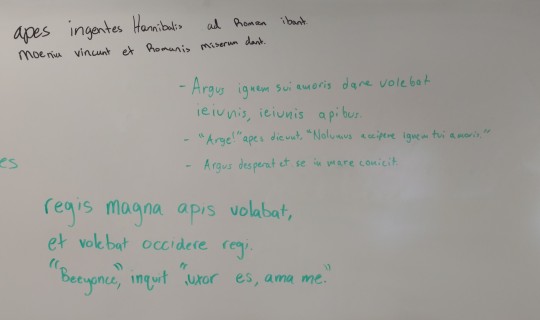
1. apes ingentes Hannibalis ad Romam ibant. Moenia vincunt et Romanis miserum dant.
“The giant bees of Hannibal
were going to Rome. They conquer the walls and give misery to the Romans.” In hindsight the noun miseriam would have been better, but still solid. Mentions bees AND misery. Implies an AU where Hannibal brought giant bees
across the Alps instead of elephants. Carthage wins the Punic Wars. 10/10
2. Argus ignem sui amoris dare volebat ieiunis, ieiunis apibus. “Arge!” apes dicunt. “Nolumus accipere ignem tui amoris.” Argus desperat et se in mare conicit.
“Argus was wishing to give
the fire of his love to the hungry, hungry bees. ‘Argus!’ the bees say. ‘We do
not want to accept the fire of your love.’ Argus despairs and hurls himself
into the sea.” Descriptive. Tragic. Mentions fire. Has something for
everyone. Also 10/10
3. regis magna apis volabat, et volebat occidere regi. “Beeyonce,” inquit, “uxor es. Ama me.”
“The great bee of the king
was flying, and he was wishing to kill for the king. ‘Beeyonce,’ he said. ‘You
are my wife. Love me.’ ” 100/10 for Beeyonce.
One of my absolute favourite concepts Vedic Sanskrit has introduced me to is the comparison by negation – basically, instead of being introduced by a comparative preposition such as like or as, the compared noun (phrase) is simply negated.
For example, “She, like a wolf, hunted them all down,” is instead “She, not a wolf, hunted them all down” (but in the former meaning).
An example from Rigveda: the Hymn to the Goddess of Night (RV X.127 Rā́trī), verse 4, lines 2 and 3:
नि ते यामन्नविक्ष्महि । वृक्षे न वसतिँ वयः ॥
ní te yā́mann_ávikṣmahi down into [our] homes we retired, vr̥kṣé ná vasatím̐ váyaḥnot birds to [their] nests on trees
(→supply like for not for an accurate translation)
The principle being that the comparison is invoked by the mere presence of the noun (phrase) the original thing is compared to, while the negation reinforces the mere comparison as opposed to it being actually real, thus “She, not [literally, but figuratively] a wolf, hunted them all down.”
So myself and two best friends got matching tattoos that say Κύριε ἐλέησον. It’s pronounced Kyrie Eleison and in ancient Greek means “Lord have mercy.” It’s one of the oldest Christian liturgical prayers and features in the Bible, and when Christianity became Latinised, it as one of the only surviving Greek prayers.
Just for fun I plugged it into Google Translate to see what modern Greek thinks of it and
10/10 A+ tat so glad its marked on my skin forever, would tattoo again
For most of its being, mankind did not know what things are made of, but could only guess. With the growth of worldken, we began to learn, and today we have a beholding of stuff and work that watching bears out, both in the workstead and in daily life.
The underlying kinds of stuff are the firststuffs, which link together in sundry ways to give rise to the rest. Formerly we knew of ninety-two firststuffs, from waterstuff, the lightest and barest, to ymirstuff, the heaviest. Now we have made more, such as aegirstuff and helstuff.
The firststuffs have their being as motes called unclefts. These are mighty small: one seedweight of waterstuff holds a tale of them like unto two followed by twenty-two naughts. Most unclefts link together to make what are called bulkbits. Thus, the waterstuff bulkbit bestands of two waterstuff unclefts, the sourstuff bulkbit of two sourstuff unclefts, and so on. (Some kinds, such as sunstuff, keep alone; others, such as iron, cling together in chills when in the fast standing; and there are yet more yokeways.) When unlike unclefts link in a bulkbit, they make bindings. Thus, water is a binding of two waterstuff unclefts with one sourstuff uncleft, while a bulkbit of one of the forestuffs making up flesh may have a thousand or more unclefts of these two firststuffs together with coalstuff and chokestuff.
At first it was thought that the uncleft was a hard thing that could be split no further; hence the name. Now we know it is made up of lesser motes. There is a heavy kernel with a forward bernstonish lading, and around it one or more light motes with backward ladings. The least uncleft is that of everyday waterstuff. Its kernel is a lone forwardladen mote called a firstbit. Outside it is a backwardladen mote called a bernstonebit. The firstbit has a heaviness about 1840-fold that of the bernstonebit. Early worldken folk thought bernstonebits swing around the kernel like the Earth around the Sun, but now we understand they are more like waves or clouds.
It’s not just Latin derivations that have been taken out and replaced by Germanic-English roots; it’s Greek and French too. The source is “Uncleftish Beholding”, by Poul Anderson (full text here, Wikipedia article here).
What English might sound like if we didn’t beat up other languages in back alleys, then? 😉
Seriously tho I love this.
Eh, be fair, French and Latin were forced upon the English.
And so was Greek, mostly by the people who brought in the French and Latin.
But yeah, what English might sound like if its speakers had always been language purists but the language had somehow survived anyway.
Ok, why is oxygen sourstuff?
Literal translation: oxygen means ‘thing that creates acid,’ aka sourness. (Hydrogen and oxygen really should have their names switched, but it is centuries too late for that now.) You can find a real-world equivalent to Anderson’s terminology in German, wherein the name for oxygen is Sauerstoff and the name for hydrogen is Wasserstoff. 🙂
“Folks, there’s nothing left from the Linguistics division. We lost all the indigenous languages collection: the recordings since 1958, the chants in all the languages for which there are no native speakers alive anymore, the Curt Niemuendaju archives: papers, photos, negatives, the original ethnic-historic-linguistic map localizing all the ethnic groups in Brazil, the only record that we had from 1945. The ethnological and archeological references of all ethnic groups in Brazil since the 16th century… An irreparable loss of our historic memory. It just hurts so much to see all in ashes.”
If you don’t love languages, hear me out: my telugu friend had been affectionately calling me, a hindi speaker, “gundi” for 7 months. We didn’t realize until recently that the word has two completely different meanings in Telugu and Hindi, and that we both had completely different interpretations of her affection.
In Telugu, “gundi” means “smol/button/round/cute”.



 ephal ephalak idon hi-akallabeth