andie, she/her, 26, united states. this blog is full of Tolkien. also other art, photos, fandoms, and big-eyes-emoji stuff, but mostly Tolkien. i tag! my girlfriend is bright ivanaskye, who is a lot, but not too much
Idk why I imagined their heads would be as firm as the rest of their bodies??
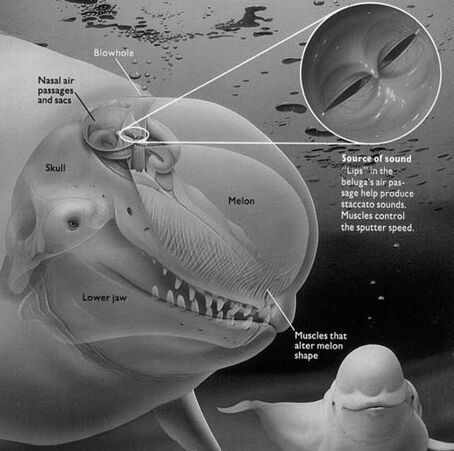
Beluga heads are super squishy specifically because of the structure they use for echolocation: the melon! All toothed whales have melons, but in belugas it is always very bulbous and protrudes out over their rostrum.
Melons are some of the coolest organs ever, IMHO, because they’re basically lumps of super fatty tissue (anecdotally, slightly more dense / less squish than human breast tissue) that allow the whales to both amplify their vocalizations and process received sound waves underwater. I’ll quote from Wikipedia here for a second, since they’ve got a nice concise description:
“The melon is structurally part of the nasal apparatus and comprises most of the mass tissue between the blowhole and the tip of the snout. The function of the melon is not completely understood, but scientists believe it is a bioacoustic component, providing a means of focusing sounds used in echolocation as well as creating a similarity between characteristics of its tissue and the surrounding water so that acoustic energy can flow out of the head and into the environment with the least loss of energy.”
What’s really cool is that there are actually layers of different densities of fatty tissue within the melon, which “creates a sound velocity gradient that refracts sound directionally,” and beluga actually have muscles underneath their melons that allow them to manipulate their shapes.
All of which is to say, melons are a) wonderful and b) full of squish, and I really wanted to talk about them on the blog so I can share this video of a melon jiggling. (It won’t let me embed it, but it is 110% worth clicking through).
highkey ready for someone to challenge me on the “blaming tragedies on the closest named female character” thing because I have the BEST meta up my sleeve
NICE CHOICE. A CLASSIC.
The more I thought about this tendency of fandom to blame every tragedy on the closest female character, the more I noticed that these women technically could have prevented whatever the tragedy was. Technically. Idril could have given Maeglin a chance, or whatever. Elwing could have surrendered the Silmaril. Melian could have stayed in Doriath to protect it.
I’m going to focus on Idril, Melian, and Elwing as women who tend to take a lot of heat for this, but you can apply this “could have” expectation to a lot of things people hold female characters disproportionately responsible for. Miriel could have tried harder to not die of elvish PPD, therefore preventing Fëanor from becoming embittered and vengeful toward the Valar and his stepfamily. Nerdanel could have tried harder to keep Fëanor’s darker impulses in check. Indis could have minded her own business and not married Finwë, I guess, and none of the story with its cascading tragedies would have ever happened.
We want someone to blame, and it’s easy to blame the women, both because we’re socialized to blame women for everything and because these could-haves seem so simple. If there was one thing you could do (even if that thing came as an intense personal sacrifice) to prevent a tragedy like the Fall of Gondolin, why wouldn’t you do it? These selfish bitches need to think about the greater good!
Each “critical female” functions narratively as a keystone in an arch. The keystone makes it possible for the arch to hold its shape, and if the keystone is removed, the arch will collapse.
(This analogy doesn’t hold up very far, but bear with me.) We tend to think of the women and their tragedies as existing in a vacuum, ignoring everything else that happened up until the Third Kinslaying, for example, that made Elwing’s “choice” so critical. In all of these cases, the “footers” of the tragedy were already in place, and the escalating pride and greed of men built the arch until the keystone woman becomes the deciding factor in the arch collapsing. However, they’re all important parts of the same arch, and the keystone woman is only the last stone placed before something happens to cause the tragedy she “could have” prevented. It’s only “her fault” because other people’s terrible choices put her in the position to make a choice between two or more awful options.
In all of these cases, the keystone woman’s tragedy is actually triggered by a man’s folly. Thingol got hilariously murdered because he and the dwarves tried to double-cross each other over jewels, and Melian (who is even less human than the elves already are) floated away in grief. Maeglin (poster child for the generational pattern of male entitlement and abuse) betrayed Gondolin because he wished to possess Idril, and the chorus of “why didn’t she give him a chance? Why couldn’t she just have been nice to him?” is WAY TOO REAL in our age of incels and mass shootings. And, of course, the sons of Fëanor perpetrated the Third Kinslaying. That’s not even a question.
Interestingly, the fate of the keystone woman seems to symbolize the fate of the people affected by their shared tragedy. Idril endures the Fall of Gondolin through her courage and resourcefulness, and her legacy is felt throughout the ages to come even if she (after going West) is only a “memory” of more glorious days. Melian departs Doriath in her grief, leaving it unprotected, just as the refugees of Doriath scattered across Beleriand when its last elven stronghold could no longer protect them. Elwing and her people choose death over the humiliation of surrendering the Silmaril, but in their death (literal or symbolic) they are lifted up (literally or morally) over their circumstances.
I’ve written before about how Tolkien treats his female characters better than people are often willing to give him credit for. These women have agency and dignity in the midst of men fucking everything up for them, and he treats them with sympathy (Melian) or as heroes (Elwing and Idril) for doing their best with bad situations. Can you imagine Idril’s story in the hands of a different (cough GRRM cough) writer? Tolkien recognizes that these women are critical parts of complex stories, and if they “could have” done something to prevent their tragedy, he does not fault them for not doing it. He knows better than to place that responsibility on one person’s shoulders. After he spent so long carefully detailing how and why all the male characters dug their own graves, he knows better than to expect their women to fix it for them.
Chapters: 2/? Fandom: The Silmarillion and other histories of Middle-Earth – J. R. R. Tolkien Rating: Teen And Up Audiences Warnings: No Archive Warnings Apply Relationships: Elrond Peredhel & Elros Tar-Minyatur, Elrond Peredhel & Ereinion Gil-galad Characters: Elrond Peredhel, Elros Tar-Minyatur, Ereinion Gil-galad Additional Tags: Post-choice, lots of mortality & immortality talk, but in a positive way, elrond is a cute bean, early second age, soon after the sinking of Beleriand Summary:
Mere days after choosing the First Kindred, Elrond decides to keep a diary … within his own memories, as they are perfect and immutable now.
“And they say it is I who daydream without end!” Elros says.
I laugh again, and walk a little closer to him, sure
as possible to see and therefore always remember the confusion in his
eyes as a leaf rests in his hair as if it wants to set up a bed there. I swipe it out of his hair with one hand, and smile. “This, brother.”
“Ah, I think I see,” Elros says, and as he says this
I cannot in the slightest help but notice the way the light is golden
against the bark of the tree he is nearest too, and oh, oh, I will be
able to watch this tree’s children grow tall and rise into golden light
too—
“You are still daydreaming,” Elros reminds me.
“A little,” I admit, recognizing that my memories of
the very moments I am experiencing are collecting around me like cloth:
a dream, a dream. “But it pleases me so, to love this moment, and to hold it forever.”
“You elf,” Elros says with a smirk of a smile.
So I know I’m SUPER BIASED and all that, since I am in love with this fic’s author and her whole brain, but I had a great need to reiterate my complete love for this incredibly kind, exploring, softly wondering character study. The sincerity and imagination in writing the POV of someone suddenly bestowed with a perfect memory – the little twists and observations twined all throughout – is the best I’ve ever seen. The gentle elation and hyperawareness of the specific Elf-ness of Elves, the experience of becoming a type of being that you technically were not before, but also was always right for you, never so much as wavers in its fidelity of perspective, even as the subject matter expands thoughtfully to the state of the world at this snapshot in time. Srsly you all should read.
Also I know the link says only 2 chapters bc it was first posted as a wip, but there r definitely 6!
It’s easy to part with silver or gold,
A cloak of wool or a toga;
But to send off a gift of mushrooms –
That’s a hard thing to bear.
Argentum atque aurum facilest laenamque togamque
mittere; boletos mittere
difficilest.
Still Life with Mushrooms, unknown Spanish artist, 17th century
I love the parallel between Elrond saying “Yet such is oft the course of deeds that move the wheels of the world: small hands do them because they must, while the eyes of the great are elsewhere” and the March on the Black gate that literally drew the Eye of Sauron away so Frodo and Sam could walk up a mountain to end their quest.
Which was of course the reason for Aragorn using the Palantir at Helm’s Deep ro tell Sauron NEENER NEENER ISILDUR’S HEIR SAYS UP YOURS, and for Gandalf the WHITE to be as flashy as possible once Frodo was no longer in the party, and for all the conventionally hero-like people to draw as much attention as they could to themselves, doing Great Deeds In War Like The Songs Say They Should.
All that derring do and glory?
A façade. A necessary façade, because they wanted to keep Rohan and Gondor from being destroyed before Frodo could finish his quest, but they knew they were fighting Sauron’s power with power (such as they had) and arms (he had vastly more armies) and neither resource was enough to beat him.
Pretty much from the time Aragorn, Gimli and Legolas joined up with Gandalf again, they were trying to be a diversion, especially after Pippin accidentally drew Sauron’s attention by making him think the Ringbearer was with Saruman and they’d rescued him. From then on, Aragorn’s every action was designed to make Sauron think he had the Ring, having taken it from the hobbit Saruman had captured. He was doing all he could to draw out Sauron’s forces away from Frodo.
Which is why I’m still not really over Peter Jackson inventing that whole sequnce of dragging Frodo to Osgiliath so he could stand on a tower and show the Nazgul he had the Ring. “HERE I’VE GOT IT, NOT ANY OF THOSE PEOPLE IN ROHAN YOU THOUGHT HAD IT!”
At which point Sauron would’ve thrown every resource he had into (a) capturing Frodo and (b) defending Mordor against infiltration by hobbitses, whose main reputation (thanks to Bilbo) is that they can sneak into a dragon’s lair without being detected.
…the moral of the story being, you damn well better understand why Tolkien did what he did before you decide you know better than Tolkien how the story ought to go.




 ephal ephalak idon hi-akallabeth