andie, she/her, 26, united states. this blog is full of Tolkien. also other art, photos, fandoms, and big-eyes-emoji stuff, but mostly Tolkien. i tag! my girlfriend is bright ivanaskye, who is a lot, but not too much
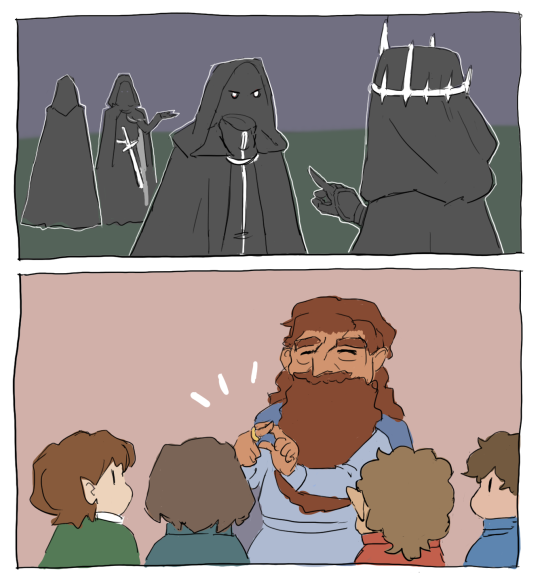
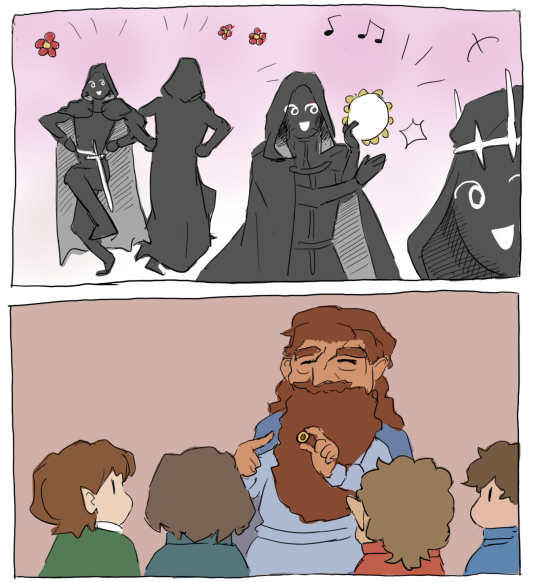
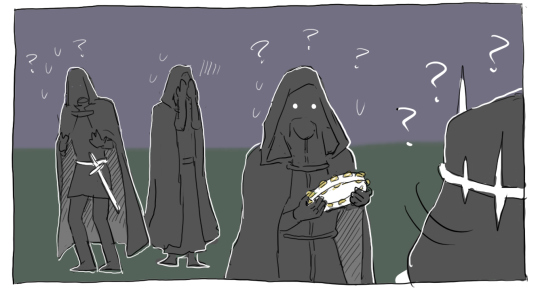
While talking with the Hobbits, Tom Bombadil puts on the One Ring. For a moment, all of the Nazgul burst into merry song. It is never discussed among them again.
Just in case you thought I was kidding – here’s the heraldry for the Mordor Special Mission Flying Corps, drawn by Tolkien himself.
“It apparently was a badge that applied to Sauron’s air-borne troops, probably including the later incarnations of the Nazgûl and, perhaps, any remaining dragons under Sauron’s command. The “wings” at the side of the emblem are given a feather-like texture, which might indicate that they were originally real wings. A mystifying scribble, saying “Seen from below”, actually hints that the emblem portrays one of Sauron’s flying creatures, and the small “horns” indicated between the wings and the body of the creature could then be the feet of someone riding the beast. But it is clear that if so, the portrait must be extremely stylized. On the wings can be seen the image of Sauron’s eye, multiplied like the eyes on peacock’s wings.” [x]
This is so undeniably cool. All I can imagine now is this Nazgul Flying Corps in WW2 outfit.
More (idonthaveanameyet) red priestess/queen turning Nazgûl ideas …before armour
[11] If they do not sink below a certain level. Since no fea can be annihilated, reduced to zero or not-existing, it is no[t] clear what is meant. Thus Sauron was /said/ to have fallen below the point of ever recovering, though he had previously recovered. What is probably meant is that a ‘wicked’ spirit becomes fixed in a certain desire or ambition, and if it cannot repent then this desire becomes virtually its whole being. But the desire may be wholly beyond the weakness it has fallen to, and it will then be unable to withdraw its attention from the unobtainable desire, even to attend to itself. It will then remain for ever in impotent desire or memory of desire.
Tolkien, J. R. R. The History of Middle-Earth X: Morgoth’s Ring. Ed. Christopher Tolkien. (London: HarperCollins, 2002.) 407-8. (Myths Transformed, Text VII “Notes on motives in the Silmarillion,“ (iii), Notes) [This is a note to this passage.] (via literallyeverythingaboutsauron)




 ephal ephalak idon hi-akallabeth