Was reading up on Maiar recently, brushing up on my lore, and there was a mention of the fact that a lot of them just don’t bother to take physical form. Even the elves in Valinor aren’t sure how many of them there are. They’re just like, weird invisible ghost friends, creeping around Middle-Earth, observing things and giving people weird dreams. Having a good time in general.
This leads to the obvious question- did Morgoth have any followers who just couldn’t be bothered with physicality? His whole evil power shtick doesn’t seem like it would attract that sort of personality, his ethos is built on interfering with things, but there had to be at least a few who hung around him just to watch the fireworks. (Sauron: Come on, guys, you’re being a real drag. At least make the effort to do a wraith form.)
Does this mean that the War of Wrath had a post-mop up ghostbusting component? Some poor Edain watching Eönwë
shout at the empty halls of a liberated Angband about “going home and facing consequences” and “I mean it this time, don’t make me come get you.”
One corner of Lórien is mildly haunted for a few millennia by some Ainur who are under house arrest for Enabling This Nonsense.
Tag: meta etc
Vegetation in Middle-Earth before the Sun: A meta that should be written by a botanist instead
Obviously starlight is most likely not enough for photosynthesis. (Of course, there has been no
need for such a plant to evolve in the real world…)What we know: There were plants everywhere during the Spring of Arda, thanks to the Lamps. After their destruction, Yavanna grieved because their growth was “stayed”, and she “set a sleep
upon many things that had arisen in the Spring, so that they should not age”.There is, however, a mention of growth in dark Beleriand – Nan Elmoth where Elwe and Melian
met and “the trees of Nan Elmoth grew tall and dark before they […]”. Hmm. Of course, that could be an exception due to Melian’s presence, seeing as it’s also mentioned how Doriath is a place of “life and joy” because of her, in contrast to most of Beleriand, and Niphredil blooms there when Luthien is born.So, the explanation is that the vegetation is under the Sleep of Yavanna, but that doesn’t mean there aren’t a few things to consider:
– Yavanna kept the plants from dying, and if that means they were frozen in time, the Elves could presumably eat them, though they wouldn’t grow back. If “Sleep” means they were like our plants in winter, nutrition becomes more problematic. Their diet might have to be mostly carnivorous, maybe supplemented with roots and nuts or fruit remnants. (Again, since none of it grows back, they’d have to forage and put themselves in danger more and more.)
– Also, there’d be funghi. Lots and
lots of funghi, possibly everyone’s main food source.– I’m also worried
about the oxygen – the ‘easiest’ explanation I can think of
is that the trees in Aman produced it and Manwe made sure
it was distributed to Middle-Earth, too. (Sounds better than ‘the
Elves didn’t need oxygen’, anyway.)– Some plants could be getting glucose from somewhere else and transforming
it into other chemicals they need, more like heterotrophs. Maybe the
soil is just full of glucose at the time, courtesy of Yavanna. They’d have pale or unusually colored leaves.– Any exceptional plants that managed to adapt to the darkness could have died out soon after the Sun rose. Which could have been
hard to get used to for the Elves and possibly Dwarves of
Middle-Earth. Imagine desperately missing your favourite plant or mushroom that used to be really common, went extinct because of the Sun and may or may not exist in Aman but the damn Noldor can’t tell you because they had so much other stuff to eat they never paid attention to the thing you’re describing (this could be part of Eöl’s villain origin story…)Oooh, I have Thoughts here. (I’m not a botanist, but I’ve had a special interest in earth history since forever, which does mean I know a lot of weird tidbits about how ecosystems work, and how they have worked in the past.)
– To start with– I expect Yavanna’s version of “sleep” for the plants would be more like stasis than like winter, given Tolkien’s tendency to associate interventions on nature by Valar and Elves with eternal spring and semi-creepy non-flowing of time way more than with winter.
– If that’s the case, the plants not growing back when the Elves eat them is a huge concern. It would probably force them to be pretty nomadic, leaving behind trails of eaten, ravaged plants in their wake. Which on one hand seems aesthetically discordant, but on another hand, it fits their history of always moving westward.
– Carnivory is not a real solution in and of itself, because the animals Elves eat would have to themselves be eating something. Maybe fungi.
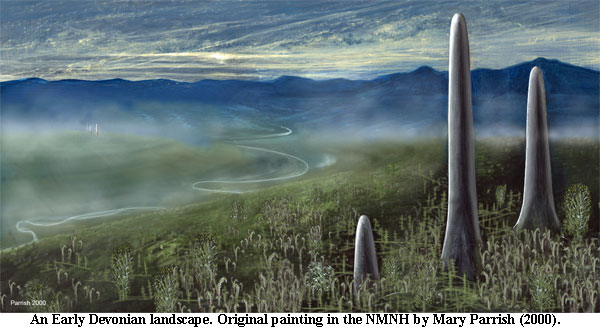
Speaking of fungi, I immediately think of Prototaxities, which is the weirdest thing you’ve (probably) never heard of. In the real-life history of the earth, right after some plants colonized the land, but couldn’t figure out how to be trees yet… the largest land organisms were giant towers of fungi that got to, like, 26 feet tall. Just look at these. Seems pretty Tolkien-compatible to me, honestly.– Chemosynthetic autotrophs (read: things that make their own energy a la photosynthesis, but by using things that aren’t sunlight) seem likely, though on Earth these are all single-celled. They could still be the base of a food chain on Tree-age Middle Earth though; maybe there’s large algal mats that synthesize something, and then fungi consume them, and then either Elves consume fungi directly, or animals eat the fungi and then Elves eat the animals.
– On Earth, chemosynthetic microbes are mostly associated with hydrothermal vents in the deep sea. This is making me imagine land equivalents of them, which would honestly be pretty cool. There could be Pillar of Big Hot Thing that’s way too hot to touch, but has a bunch of animals congregating around it to eat the microbe mats.
– Except that that isn’t quite how hydrothermal vents would work on land; in fact they already kind of do exist on land (geysers and hot springs), but I think the fact that super-hot temperatures don’t boil water when it’s under the kind of pressure it’s under in the deep sea makes a difference…
– Anyway, there’s probably not a direct equivalent, but animals and/or fungi specialized to eat those super-colorful microbes that show up in yellowstone hot springs? Yellowstone-like terrain as some of the most sustaining of life? It’s something to consider.
– There are some other weird chemotrophs out there, too—like bacteria that get their energy from rusting iron. I don’t think they’re very edible, though.
– On the other hand, some weird, non-edible chemotrophs actually make oxygen! There’s a type of bacteria that eats methane and produces oxygen as a waste product, for instance. So that may help with OP’s concerns around oxygen.
– I kinda think that it would be really cool if there were chemosynthetic organisms that weren’t single-celled. Imagine Yellowstone-like hot springs with big ruffly almost-plants at the edge! This would almost definitely be an entirely different kingdom of life, by RL terms, which would be really cool…
– …But since it’s really hard to wipe out entire kingdoms of life, I don’t think that all of these would have died when the Sun came into existence. There’d probably still be pockets of Middle Earth where some early first-age not-plants yet thrive.
– Which is also really Tolkien. I like it.
Tl;dr definitely giant towers of fungi, probably hot springs as one of the best places to get food, very possibly consumed-and-not-regrowing sleeping plants pushing the Elves ever westward.
Vegetation in Middle-Earth before the Sun: A meta that should be written by a botanist instead
Obviously starlight is most likely not enough for photosynthesis. (Of course, there has been no
need for such a plant to evolve in the real world…)What we know: There were plants everywhere during the Spring of Arda, thanks to the Lamps. After their destruction, Yavanna grieved because their growth was “stayed”, and she “set a sleep
upon many things that had arisen in the Spring, so that they should not age”.There is, however, a mention of growth in dark Beleriand – Nan Elmoth where Elwe and Melian
met and “the trees of Nan Elmoth grew tall and dark before they […]”. Hmm. Of course, that could be an exception due to Melian’s presence, seeing as it’s also mentioned how Doriath is a place of “life and joy” because of her, in contrast to most of Beleriand, and Niphredil blooms there when Luthien is born.So, the explanation is that the vegetation is under the Sleep of Yavanna, but that doesn’t mean there aren’t a few things to consider:
– Yavanna kept the plants from dying, and if that means they were frozen in time, the Elves could presumably eat them, though they wouldn’t grow back. If “Sleep” means they were like our plants in winter, nutrition becomes more problematic. Their diet might have to be mostly carnivorous, maybe supplemented with roots and nuts or fruit remnants. (Again, since none of it grows back, they’d have to forage and put themselves in danger more and more.)
– Also, there’d be funghi. Lots and
lots of funghi, possibly everyone’s main food source.– I’m also worried
about the oxygen – the ‘easiest’ explanation I can think of
is that the trees in Aman produced it and Manwe made sure
it was distributed to Middle-Earth, too. (Sounds better than ‘the
Elves didn’t need oxygen’, anyway.)– Some plants could be getting glucose from somewhere else and transforming
it into other chemicals they need, more like heterotrophs. Maybe the
soil is just full of glucose at the time, courtesy of Yavanna. They’d have pale or unusually colored leaves.– Any exceptional plants that managed to adapt to the darkness could have died out soon after the Sun rose. Which could have been
hard to get used to for the Elves and possibly Dwarves of
Middle-Earth. Imagine desperately missing your favourite plant or mushroom that used to be really common, went extinct because of the Sun and may or may not exist in Aman but the damn Noldor can’t tell you because they had so much other stuff to eat they never paid attention to the thing you’re describing (this could be part of Eöl’s villain origin story…)
Random headcanon: In Noldorin culture, it’s considered acceptable, even necessary, to politely correct other people when you notice them making mistakes, since that way you’re helping them learn and improve. Unconstructive, deliberately nasty criticism, the sort that can make someone feel they’re so bad at it they shouldn’t even try anymore, is considered the worst thing you could do, but letting others keep doing something wrong can be seen as almost as rude. That extends from art, craft or music to things like grammar, spelling, pronounciation. (The exception would be if it’s obvious that the person wants to finish whatever it is by themselves.)
Of course, that means other Elves and Edain, whose stance on help is more “if we need it we’ll ask for it”, may sometimes view them as pushy know-it-alls. Like, if someone tried learning Quenya and every other sentence someone interrupted with corrections and advice. Or worse, if the Edain were building something and these perfect-seeming Elves show up with advice and offers to help and they clearly mean well but it’s not exactly helping with the inferiority complex some Edain were already developing. (Some Noldor did realize that this could be viewed as annoying, and became thoroughly unhelpful to members of other cultures but I’m totally not looking at anyone specific here…)


im gonna redraw this one day but yknow,, that scene from the return of the king
((click bc tumblr quality suckss))
Tame a strong woman? Ex-fucking-cuse you? I would break his balls right then and there.
I can’t believe there are people on tumblr dense enough to think that Tolkien wasn’t sexist.
You realize that Eowyn is LITERALLY calling out Gondorians for their enormous superiority complex by joking about it. You realize she’s basically saying “all of your frivolous court will never shut up about us because they look down on my people. One of you should never marry one of me, according to them.” Eowyn is LITERALLY LISTING THE STEREOTYPES the Gondorian gossip machine will produce.
Faramir is playing along. By saying to Eowyn: “I would.” he’s not saying- “yes I want them to hype my own ego.” Instead he’s saying: “Let them talk, I don’t care about what people are going to say because I love you”. Not only is he, through these two words acknowledging the Gondorian elites are classist and snobby but he’s saying they can all sod off. Faramir and Eowyn can communicate in sarcasm and cryptic phrases because they are so in tune they will understand the nuances in what the other is saying.
The book LITERALLY SAYS that when Faramir kisses her he “cared not that they stood high upon the walls in the sight of many.” He doesn’t care what people are going to say about them because he loves her that much.
This little piece of dialogue shows us 1. Tolkien is acknowleding his world has a Gondorian-Rohan hierarchal structure and is making sure this is addressed so we are safe in the knowledge Eowyn will not end up in a sucky hierarchal marriage 2. Faramir loves her so much he would GLADLY undergo the gossip machine and all it’s associated baggage 3. They are so in tune they can communicate these thoughts in two words. We are assured theirs will be a happy marriage.
If you want to be ugly about this couple would you mind not doing it on this comic I spent over 24 hours lovingly creating? Thanks.
Arien and the Early Edain
Arien has always had a particular affection for humans, ever since they awoke in the ancient, then-lush depths of the East. Her first rising followed the path of their western steps and her light intimidated Melkor’s servants, such that humans did not fear to travel by day. She felt that the distance of the Ainur was an injustice. Orome had come or the elves in Cuivenen, why had no one come for the mortals?
She loves their drama and their internal, quick-burning flame. In ancient days, she would often adopt a human like form and move among them as an innocuous-looking woman with golden-hair. Meanwhile, a portion of her multi-present consciousness would hold the burning sun in orbit. Early bands of travelling Edain would pay little or no heed to the strange, intuitive, young woman that moved among them with an attentive fascination for their concerns and conversations.
When her travelling “friends” would reach a group of protective Eldar, they would often find that their travelling companion had vanished.
Though her journeys are less frequent nowadays, Arien still travels.
“What kind of person was Lancelot? I know about half the kind of person he was, because Malory contented himself with sharing the obvious half. He was more interested in the plot than the characters, and, as soon as he had laid down the broad lines of the latter, he left it at that. Malory’s Lancelot is:
1. Intensely sensitive to moral issues.
2. Ambitious of true – not current – distinction.
3. Probably sadistic or he would not have taken such frightful care to be gentle.
4. Superstitious or totemistic or whatever the word is. He connects his martial luck with virginity, like the schoolboy who thinks he will only bowl well in the march tomorrow if he does not abuse himself today.
5. Fastidious, monogamous, serious.
6. Ferociously punitive to his own body. He denies it and slave-drives it.
7. Devoted to ‘honour,’ which he regards as keeping promises and ‘having a Word.’ He tries to be consistent.
8. Curiously tolerant of other people who do not follow his own standards. He was nor shocked by the lady who was naked as a needle.
9. Not without a sense of humour. It was a good joke dressing up as Kay. And he often says amusing things.
10. Fond of being alone.
11. Humble about his athleticism: not false modesty.
12. Self-critical. Aware of some big lack in himself. What was it?
13. Subject to pity, cf. no. 3.
14. Emotional. He is the only person Mallory mentions as crying from
relief.
15. Highly strung: subject to nervous breakdowns.
16. Yet practical. He ends by dealing with the Guenever situation pretty well. He is a good man to have with you in a tight corner.
17. Homosexual? Can a person be ambi-sexual – bisexual or whatever? His treatment of young boys like Gareth and Cote Male Tale is very tender and his feeling for Arthur profound. Yet I do so want not to have to write a ‘modern’ novel about him. I could only bring myself to mention this trait, if it is a trait, in the most oblique way.
18. Human. He firmly believes that for him it is a choice between God and Guenever, and he takes Guenever. He says: This is wrong and against my will, but I can’t help it. It seems to me that no 17 is the operative number in this list. What was the lack? On first inspection one would be inclined to link it up with no 17, but I don’t understand about bisexuality, so can’t write about it. There was definitely something ‘wrong’ with Lancelot, in the common sense, and this was what turned him into a genius. It is very troublesome. People he was like:
1. Lawrence of Arabia,
2. A nice captain of the cricket,
3. Parnell,
4. Sir W Raleigh,
5. Hamlet,
6. me,
7. Prince Rufant,
8. Montros,
9. Tony Ireland or Von Simm […] or whatever,
10. Any mad man,
11. Adam.”— T.H. White’s notes on the character of Lancelot. (via the-library-and-step-on-it)
Turgon is an
interesting figure. I think in some ways he’s the most like Feanor
out of their entire family.Love not too well the work of thy hands.
That’s
not something said to Feanor: it’s what Ulmo says to Turgon.
Turgon makes exactly
the same choice that Feanor did: Feanor refused to destroy the
Silmarils at the urging of the Valar, and Turgon refuses to forsake
Gondolin. Turgon is an artist,
and he loves the city he built.Feanor went a bit crazy when Morgoth killed
Finwe and stole the Silmarils, and Turgon doesn’t seem much saner
when he dies (“Great is the might of the Noldolie,” he shouts as his city is burning, right before death by architecture.)Turgon
is also, I think, the most acutely aware of all his family, save
Feanor, of the possibility of loss. Feanor
was driven by a deep seated fear that things could be taken from him.
It’s ultimately what drives his feud with Fingolfin (you would
take my father’s love from me?). And it seems to drive Turgon too (yes, let’s make a hidden city where I can keep everyone safe!). In
Feanor’s case, it was triggered by the death of his mother and the
remarriage of his father (I can be replaced);
in Turgon’s by Elenwe’s death and then Aredhel’s.Anyways,
I need to think about this more.
Oromë and Atani Religion
Companion piece to this post. I got to thinking about who the most recognizable Vala would be to Middle-earth’s Men, and came to the conclusion that it’s probably Oromë.
Of all the Valar, Oromë most loved the lands outside Valinor. It’s said that he left them unwillingly and was the last to come west, and that he often returned with his host to the East to hunt monsters and beasts, and the shadows fled for a while when they hunted. When he did remain in Valinor Oromë would train his folk and beasts for the pursuit of Melkor’s evil creatures.
Oromë is also the one who finds the elves at Cuiviénen, which essentially rescues them from extinction or worse at Morgoth’s hands. He is filled with wonder at these new beings and stays for a while to teach them. After the first war against Morgoth, the elves are afraid of all the Ainur except for Oromë, having seen the rest only in their wrath. He then shepherded the three elf representatives to Valinor and back, and then accompanies all of the Eldar from Cuiviénen to Beleriand and leads them with great care to assure their safety.
And when the humans wake up many years later, their first teachers are the elves who remained behind and who would have told them stories about the Valar and Morgoth. But these elves probably know very little about the Valar who remained in Aman, enough just to say that there are good powers off in the West. Except for Oromë. About him, the elves can say that they personally met a living, physical near-god, who walked the same forests where humanity’s feet now step,and that he taught them, protected them and wanted the best for them.
So you have this one Vala who is differentiated from the others by his love for mortal lands, who doesn’t abandon Middle-earth and goes back and makes conditions better there, and spends all his time in paradise training to do it again. He’s physically present, he’s active. He is defined by a very human set of activities (hunting, riding, fighting), emotions (love, longing, wrath) and objects of those emotions (horses, hounds, trees, eastern lands, evil). In comparison to many of the other Valar who are distant and less human, Oromë is a much more approachable, understandable figure.
For a human in Middle-earth, it would be these detailed stories of a human-like mentoring power that would seem reasonable, memorable and appealing. Such a power might cast his thought back toward Middle-earth (and thus humans) more often than his fellows and be more likely to hear and act if called upon. Then you have stories of him conquering evil, and
Oromë
becomes even more attractive as a heroic figure. He is so eager, in fact, to fight evil that when he’s in Valinor
Oromë
spends all his time training to go back. It is a very short step to believing that he might be eager and willing to help a human proxy do the same. Apply a kind of transitive logic and Oromë can be cast as a patron of humanity.
Oromë is also very geographically grounded in Middle-earth, which increases his appeal for us tactile human adherents; there are scattered signs of his physical presence even into the Third Age. The Misty Mountains, for example, were according to lore raised by Melkor to hinder Oromë’s hunts for evil creatures. The Horn of Gondor (used most famously by Boromir) was made from the horn of a Kine of Araw, which were cattle found near the Sea of Rhun and said in legend to be descended from ancestors brought by Oromë from Valinor. The ancestors of the Mearas were also, according to Rohirric tradition, originally brought to Middle Earth from Valinor by Oromë.
Whatever lies Morgoth taught Men later, all of this is a very compelling narrative. And stories about Oromë had plenty of opportunity to spread thanks to early Avari-human contact, and are renewed by the reentry of the Noldor into Beleriand, who would have passed those stories east through their kin, by human refugees from the west during the wars and after Beleriand’s destruction, by the Numenoreans as they sailed east and colonized Middle-earth, and perhaps even by the Istari.
And this mythic persistence is largely supported by our evidence. He appears in the language of the Rohirrim as ”Bema”, where he seems deeply embedded in their mythic culture (Theoden on Snowmane is compared to Orome atop Nahar, for example, and their heraldry symbol is the white Mearas, which is one of Nahar’s kin) and in the geographic legends I mentioned earlier. Since the Rohirrim are closely related to other peoples descended from the Northmen, it seems likely that the Men of Dale, Beornings, Woodsmen, and various other peoples of northern Rhovanion also had similar traditions. If we extend that influence a little further into space and time, the Variags probably included Oromë in their mythology because of their origin with the ancestors of the Rohirrim, and perhaps also the Dunlendings, who mixed frequently with the Rohirrim, and the Hobbits, whose ancestors lived nearby and whose language still carries traces of contact.
Because of their location at the very edge of elven and Edain influence, the Northmen are not as religiously orthodox as the Numenoreans. They acknowledge Eru as the creator but he figures very little into their beliefs; the Ainur have greater importance and religious influence. Some of the northern peoples, like the Beornings and the Woodsmen, are teetering right on the edge of ‘paganism’ and the Variags in the Third Age have fully embraced polytheism.
Besides Oromë, the Northmen are naturally drawn to Valar who are closely connected to him.
Vána, his wife, is associated with spring, fertility, beauty, romantic love, the growth of plants and agriculture, and is the protector of young people. To his sister Nessa is attributed power over untouched nature, wild animals, sports, dance, childbirth, and the protection of children. The two are usually conceived as the opposite ends of a natural continuum, with Vána at one end as the gentle, domesticated natural world controlled by humans and Nessa on the other as embodying the untamed, instinctive, dangerous aspects of wilderness. Oromë unites them as the patron of domestic animals, forests, human activities, crafts, culture, war, justice and good.
Some universal observances and traditions exist. According to legend, Oromë and his maiar can sometimes sneak out of Valinor, and they ride Middle-earth like they did when the world was young and hunt evil disguised as spirits. The Northmen call this the Wild Hunt and believe they only appear on moonless or stormy nights. You are supposed to leave a threefold libation outside your door to offer them refreshment when they pause to rest: offal for the hounds, grain for the horses, and mead (Rohirrim, Variags), milk (Beornings), ale (Woodsmen) or wine (Dale) for the huntsmen.
Vána is honored foremost during a spring festival, situated sometime after the first flowers of spring and planting the spring crops, but there is a companion holiday in the fall for planting winter wheat and other winter crops.
Vána can always be identified in art by her crown of flowers. Nessa also has two corresponding observances. The main one is in early to mid-fall, during the rut, while the matching holiday is in late spring to early summer, when the deer give birth to fawns. Nessa always wears a crown of antlers in their iconography. The purpose of all these observances is to ensure the productivity of both plants and animals to nourish the people.
The Northmen believe the blowing of a horn is the surest way to dispel enchantment and evil magic, and to drive out bad spirits, who flee in fear at the echo of the Valaróma. Horses and hounds are said to have special powers to sense evil and ill intent, and the greatest capacity for loyalty and love of humans. Mistreatment and cruelty to animals is the surest way to draw Oromë and Nessa’s anger and will lead to misfortune, as will disrespect for the animals you hunt and the unneeded felling of trees. You offer a prayer to Oromë before every hunt for his favor, and when you make a kill you dedicate it to the Huntsman, so his sister doesn’t become offended at the death of her creatures. Hunting deer has extra customs – killing a doe with an unweaned fawn is forbidden by Nessa, as is killing white, spotted or other unusual colored animals, since they are ‘marked’ by the two Valar as their own. Hunting in the sacred groves dedicated to Nessa is also strictly forbidden.
While there is a pretty consistent mythology, each of the different groups have their own unique traditions. The Rohirrim and the Variags, of course, favor Oromë’s aspect as ‘The Great Rider’ and most of their art shows him mounted on Nahar. You can always tell it’s him because Nahar has six legs, representing his ability to carry
Oromë over the land and sea. They also have a truly staggering number of native horse related traditions, not all of which are the same. The Rohirrim have a strict taboo against eating horseflesh, for example, while the Variags think that horsemeat is the only appropriate food for celebrations and significant events, though both justify this custom because
Oromë favors horses. The Rohirrim also honor a unique warrior aspect of Nessa, who is the patron of shieldmaidens, and equivalent to
Oromë as a war god. The Men of Dale prefer to honor
Oromë as the Huntinglord, while the Beornings and the Woodmen of Mirkwood invoke him as the Lord of Forests and the Huntsman.
I like to think that scraps of Oromë’s myth survived even in the Uttermost East. The Avari told Men stories of the world trees of the West, and of a demigod who walked among them and who hunts the leaping stag in the forest, and sometimes if Men tell the story enough times the three become the same – the stag-god with the world tree as his horns.
i just saw someone argue that the ‘reality’ of aragorn and arwen would be more in the nature of a political alliance than a fairy-tale romance and i’m like.
arright now my friend explain to me what anybody besides aragorn stood to gain from that marriage that would lead to its arrangement. what on middle earth anyone in elrond’s family stood to gain from marrying back into Elros’ line at the expense of Arwen’s otherwise perpetual life.
what would that negotiation look like. why would that be a thing.
because i am coming up with zero theories.
elrond’s whole cohort is in the process of leaving the entire relevant continent! elrond himself made the conscious decision not to at any stage press any of his multiple potential hereditary claims to kingship.
even galadriel is offski, and celeborn does not give a single flying fuck about Gondor except inasmuch as his granddaughter is going to rule it. aragorn has nothing to bring to this marriage but himself.
and a kingdom, admittedly, but considering the codicil of ‘will get to rule it for less than 200 years and then die’ i think that was categorized more under ‘least you can do’ than actual inducement. conceivably arwen could really really want to be a queen, enough to die for the privilege, but that’s. far-fetched, and not exactly an arranged political marriage anymore.
you would really have to seriously rewrite massive swathes of the worldbuilding for that idea to make the slightest sense. what definition of ‘realism’ is being applied here because i…don’t think it’s a useful one in the lotr setting.
 ephal ephalak idon hi-akallabeth