andie, she/her, 26, united states. this blog is full of Tolkien. also other art, photos, fandoms, and big-eyes-emoji stuff, but mostly Tolkien. i tag! my girlfriend is bright ivanaskye, who is a lot, but not too much
Hobbits inviting First Age elves over for tea and cake
Height differences
*Reaches up to poke in the chest* "Now listen here. I don’t know who this Fëanor is, but I don’t think he could match my great-grandmother’s silverware, do you?“
Height differences
Tea and cake and long conversations about growing vegetables
“The fact is that ‘rabbit’ is a peculiar word. The OED can find no ultimate etymology for it, nor trace it back in English before 1398. ‘Coney’ or ‘cunny’ is little better, going back to 1302, while ‘bunny’ is a pet-name used originally for squirrels, as it happens, and not recorded till the seventeenth century. The words for ‘rabbit’ differ in several European languages (French lapin, German kaninchen), and there is no Old English or Old Norse word for it at all. These facts are unusual: ‘hare’, for instance, is paralleled by Old English hara, German hase, Old Norse heri, and so on, while the same could be said for ‘weasel’ or ‘otter’ or ‘mouse’ or ‘brock’ or most other familiar mammals of Northern Europe. The reason, of course, is that rabbits are immigrants. They appeared in England only round the thirteenth century, as imported creatures bred for fur, but escaped to the wild like mink or coypu. Yet they have been assimilated. The point is this: not one person in a thousand realizes that rabbits (no Old English source) are in any historical way distinct from mice (O.E. mýs) or weasels (O.E. weselas), while the word is accepted by all as familiar, native, English … Rabbits prove that novelties can be introduced into a language and then made to fit—of course as long as one exhibits due regard to deep structures of language and thought. ‘If a foreign word falls by chance into the stream of a language’, wrote Jacob Grimm, ‘it is rolled around till it takes on that language’s colour, and in spite of its foreign nature comes to look like a native one.’
Now this situation of anachronism-cum-familiarity certainly has something to do with hobbits. … Smoking later appears as not just a characteristic of hobbits, but virtually the characteristic, ‘the one art that we can certainly claim to be our own invention’, declares Meriadoc Brandybury (LOTR, p. 8). But what are they smoking besides pipes? ‘Pipeweed, or leaf’, declares the Lord of the Rings Prologue firmly. Why not say ‘tobacco’, since the plant is ‘a variety probably of Nicotiana’? Because the word would sound wrong. It is an import … reaching English only after the discovery of America, sometime in the sixteenth century. The words it resembles most are ‘potato’ and ‘tomato’, also referring to new objects from America, eagerly adopted in England and naturalised with great speed, but marked off as foreign by their very phonetic structure. ‘Pipeweed’ shows Tolkien’s wish to accept a common feature of English modernity, which he knew could not exist in the ancient world of elves and trolls, and whose anachronism would instantly be betrayed by a word with the foreign feel of ‘tobacco’ … .[‘Tomatoes’ was eliminated from The Hobbit in revised editions.] ‘Potatoes’ stay in, being indeed a specialty of Gaffer Gamgee, but his son Sam has a habit of assimilating the word to the more native-sounding ‘taters’— … but in fact the scene in which Sam discusses ‘taters’ with Gollum (LOTR, p. 640) is a little cluster of anachronisms: hobbits, eating rabbits (Sam calls them ‘coneys’), wishing for potatoes (‘taters’) but out of tobacco (‘pipeweed’). One day, offers Sam to Gollum, he might cook him something better—‘fried fish and chips’. Nothing could now be more distinctively English! Not much would be less distinctively Old English. The hobbits, though, are on our side of many cultural boundaries.
That, then, is their association with rabbits. … both insinuated themselves, rabbits into the homely company of fox and goose and hen, hobbits into the fantastic but equally verbally authenticated set of elves and dwarves and orcs and ettens. One might go so far as to say that the absence of rabbits from ancient legend made them not an ‘asterisk word’ but an ‘asterisk thing’—maybe they were there but nobody noticed. That is exactly the ecological niche Tolkien selected for hobbits, ‘an unobtrusive but very ancient people.”
– Tom Shippey,
The Road to Middle-earth. Boston: Houghton Mifflin, 2003, rev. ed., pp. 68-69
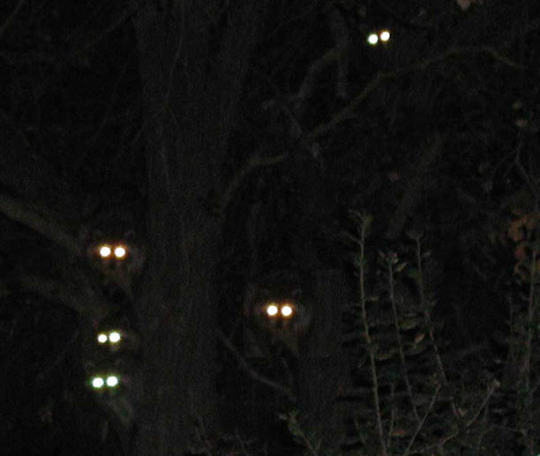
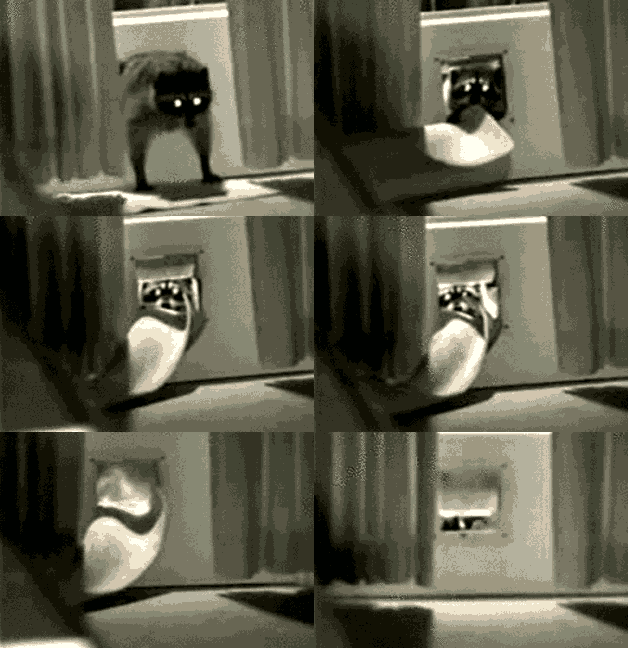
also consider: LOTR but hobbits have Tapeta Lucidum
Boromir gets the fright of his life their first night on the road
Boromir: *glances over his shoulder* ??!!!!???!!
Hobbits:
Hobbits: what
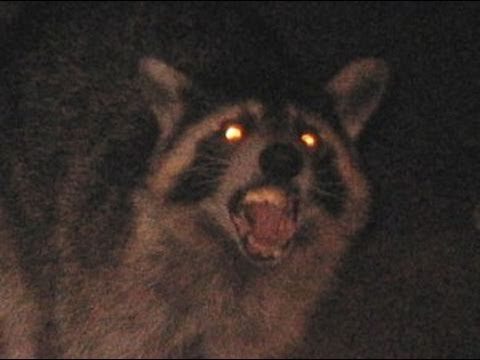
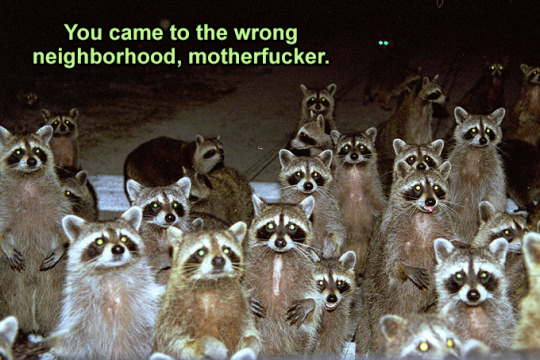
i will never get over that you used an image of raccoons for this purpose because it is incredibly accurate
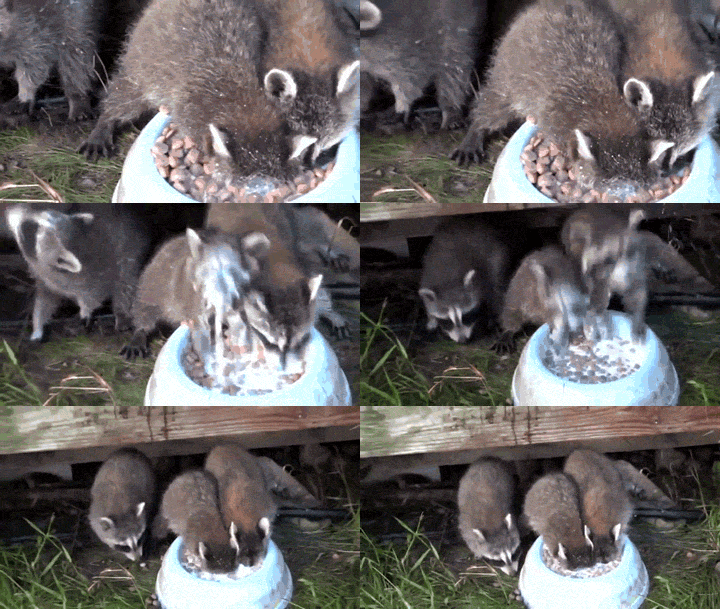
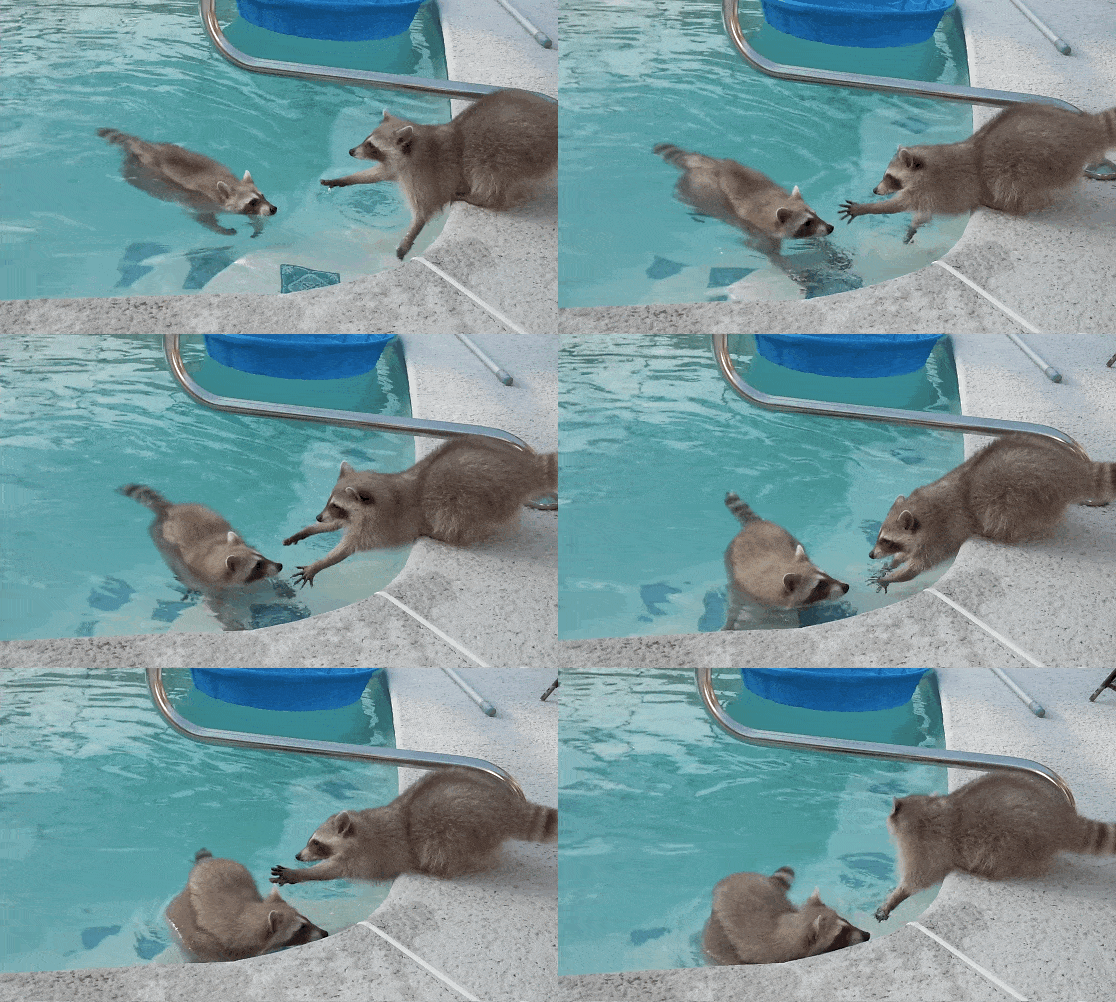
LOTR au but instead of hobbits literally raccoons
Gandalf: well this raccoon found the ring and has been carrying it around. unfortunately we can’t take it off him or he gets very bite-y. so I figure, the raccoon is the ringbearer now
Elrond: what are those other three raccoons doing here
Gandalf: he brought his buddies. I call this one ‘Merry’
Aragorn: *watching Frodo & Sam scamper off in the direction of Mordor* our hopes lie with those raccoons now
Legolas: do they… know where they are going
Aragorn: I sure hope so
Faramir: father why is this raccoon in the livery of the citadel
Denethor: haha doesn’t he look precious
Elfhelm: Dernhelm, is that a raccoon in your bag?
Dernhelm: *sweating nervously* Uh no, sir.
Eowyn, later: And I said no, you know, like a liar.
Denethor: WHY did you let a raccoon go off with the Ring??
Faramir: ….it just seemed like the right thing to do
Gandalf: he scratched you up real good huh
Faramir: ……………gouged my FUCKING arm and bit me on my face
Witch King: no living man can kill me – AUGH FUCK, RACCOON, RACCOON ON MY LEG ARGHHHH
Eowyn: *stab*
Wraiths break into the room at the prancing pony: *UnHoLy ScReEcHiNg*
Trash Panda Hobbits:
Wraiths: Oh, what the fuck, whAT THE FUCK IS THAT?!
Treebeard: Baroom, humm, where are my small, impatient friends?
Merry and Pippin:
Don’t go where I can’t follow, Mr. Frodo.
~~~~~~The Hobbit interlude~~~~~~
Thorin:
You’re the burgular.Go on and…burgle something! Bilbo:
Saruman: Well since some fucking TREES took over Isengard I guess I’ll take over The Shire. Farmer Maggot and ever other Halfling down to the Sacksville-Bagginses:
In the early 1800s a man named Little Jon lived in this so called earth cabin (swe. ‘backstuga’) located in southern Småland, Sweden. An earthen cabin is built partially buried in the ground, in this case there’s three walls of stone and one wall made of wood. In Sweden earthen cabins was common in the forests from the 1600s until the late 1800s Link




 ephal ephalak idon hi-akallabeth