andie, she/her, 26, united states. this blog is full of Tolkien. also other art, photos, fandoms, and big-eyes-emoji stuff, but mostly Tolkien. i tag! my girlfriend is bright ivanaskye, who is a lot, but not too much
An assignment I actually wrote on the board this week:
In groups, write 2 sentences (in Latin) using only the
vocabulary in your textbook. Make sure to include:
1 irregular verb
1 imperfect verb
5 cases
BEES?
I’ll elaborate in a minute, but I need to stop laughing
first.
So I’d originally planned on a 20-minute grammar lesson,
followed by a handout to be finished in pairs, but I’d made the mistake of telling
this class about Latin Day in April and how we were encouraging them to come to
school in costume. All they wanted to do was talk about costume opportunities
(and since I would like to keep my job, I had to explain why staging Caesar’s assassination
in the middle of the lunchroom would be a Bad Idea), so I shifted gears and decided
to channel that creative/social energy into a different assignment.
After lugging them through a condensed version of the
grammar lesson on irregular verbs in the imperfect tense, I split them into
groups and pulled an assignment out of the air.
The requirements:
Write two sentences in Latin
Use ONLY vocabulary from the textbook
Include at least ONE irregular verb
Include at least ONE verb in the imperfect tense
Include 5 (out of 6, including the vocative)
cases
The goal:
To write them on the board for their ‘rival’
groups to translate
They are a competitive bunch, so I knew this would be enough
to encourage them to go All Out. But then one student raised her hand.
“Can our sentences be about bees?” she asked.
Bees. I swear this class has a thing with Bees. I hesitated.
“There are no bees in your textbook.”
“Yes, but you taught us that word.”
I had, back when this same student had asked me how to say “the
bees are suffering” for a kahoot she was writing. Granted, this same student is
planning on coming in on Latin Day dressed as Caligula’s horse, so none of this
surprises me.
I opened it up to the other ‘groups’. “What do you think?” I
asked. “Should we let them write about bees?”
“No,” said one student with a heavy sort of solemnity, looking
me dead in the eye. “We should all be required
to write about bees.”
As the rest of the class eagerly cheered and nodded in
agreement, three things occurred to me.
The word for bee, “apis”, is a 3rd-declension
i-stem noun, which they could use more practice on.
They’re going to want to describe the bees,
which means they will likely also be practicing noun-adjective agreement with a
3rd-declension i-stem noun, which they could also use more practice
on.
This could be flipping hilarious.
And so I added “BEES?” to the list.
The results:
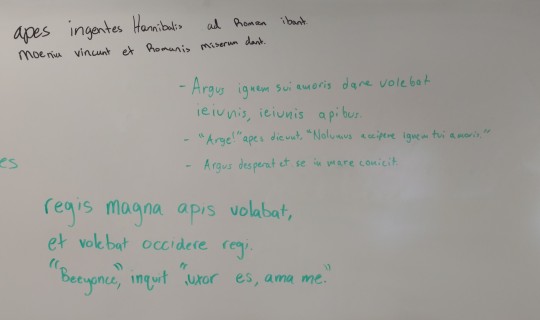
1. apes ingentes Hannibalis ad Romam ibant. Moenia vincunt et Romanis miserum dant.
“The giant bees of Hannibal
were going to Rome. They conquer the walls and give misery to the Romans.” In hindsight the noun miseriam would have been better, but still solid. Mentions bees AND misery. Implies an AU where Hannibal brought giant bees
across the Alps instead of elephants. Carthage wins the Punic Wars. 10/10
2. Argus ignem sui amoris dare volebat ieiunis, ieiunis apibus. “Arge!” apes dicunt. “Nolumus accipere ignem tui amoris.” Argus desperat et se in mare conicit.
“Argus was wishing to give
the fire of his love to the hungry, hungry bees. ‘Argus!’ the bees say. ‘We do
not want to accept the fire of your love.’ Argus despairs and hurls himself
into the sea.” Descriptive. Tragic. Mentions fire. Has something for
everyone. Also 10/10
3. regis magna apis volabat, et volebat occidere regi. “Beeyonce,” inquit, “uxor es. Ama me.”
“The great bee of the king
was flying, and he was wishing to kill for the king. ‘Beeyonce,’ he said. ‘You
are my wife. Love me.’ ” 100/10 for Beeyonce.
This little bee hatchling is one of the several leaf cutter bee species
that are native to the UK. They’re valuable pollinators in the garden
and a gardener’s friend 😀 Signs of their presence can be seen in plants that have had elliptical shapes cut from their leaves, particularly on roses.
Thank you so much to Emily Doorish for allowing us to share this video,
helping to raise awareness of the importance of solitary bees during #SolitaryBeeWeek.
Bumblebees; purring bees; nectar-drunk sticky bees; golden bees; tiny bees like ants in skirts; space bees; bees that have worked out scientifically that they are unable to fly, and as a consequence use a catapult to get everywhere; drowsy summerbees swinging from roses; reformed killer bees that are using their powers for good; bees in flowertubes sharing nothing but a buzz; bees in bonnets; bees that have become tired of costume drama; honeybees; silver-plated moneybees; gothic batbees brooding in your tulips; bees that have run out of thyme; those bees that are always on the wrong side of windows; bees that come in threes; hypersonic chasey-bees; dessicated dead ones; bees bigger than the large item that you use in your head to compare bee length and/or volume against; bees swarming around bears; those that have sneaked inside an empty beekeeping costume and are having fun moving the arms and legs around; bees of unusual buzzitude; bees beeing where they should not bee; those that will carry a message for you across a mile of deadly forest; watching-bees and waiting-bees.
i really just adore latin diminutives. for all of u who want to embrace ur inner vergil, here’s the cutest term of endearment ever because bees are the most adorable
apparently this is a picture of a bee sleeping which is the best thing so enjoy



 ephal ephalak idon hi-akallabeth