andie, she/her, 26, united states. this blog is full of Tolkien. also other art, photos, fandoms, and big-eyes-emoji stuff, but mostly Tolkien. i tag! my girlfriend is bright ivanaskye, who is a lot, but not too much
Angels standing and bowing to perform salat [Source]
The Angel Gabriel cleansing Mohammed’s heart of impurities in preparation for his ascent to heaven, while the other angels watch. From The Progress of the Prophet Turkey (1500s) [Source]
Mohammed presented to the monk Abd al Muttalib and the inhabitants of Mecca Turkey (1700s) [Source]
Shah Quli An angel, flying, with cup and wine flask Turkey (1307-1922) [Source]
Angels (Arabic: ملائكة malāʾikah; singular: ملاك or مَلَكْ malāk) are heavenly beings mentioned many times in the Quran and hadith. Unlike humans or jinn, they have no free will and therefore can do only what God orders them to do. An example of a task they carry out is testing individuals by granting them abundant wealth and curing their illness. Believing in angels is one of the six Articles of Faith in Islam. Just as humans are made of clay, and jinn are made of smokeless fire, angels are made of light.
There are several angels with names, just like in Judaism and Christianity. I’ve already blogged about Raphael/Israfil, but the far more famous angel is Gabriel/Jibreel/جبريل/Jibrail/جبرائيل, the Angel of Revelation:
According to the Quran, God sent the Quran to the Islamic prophet Muhammad through His angel Gabriel (Jibra’il) and sent a message to most prophets, if not all, revealing their obligations. Gabriel is named numerous times in the Quran (2:97 and 66:4 for example). In 2:97, the Quran expressly narrates:
Who is an enemy to Gabriel! For he it is who hath revealed (this scripture) to thy heart by God’s leave, confirming that which was (revealed) before it, and a guidance and glad tidings to believers.
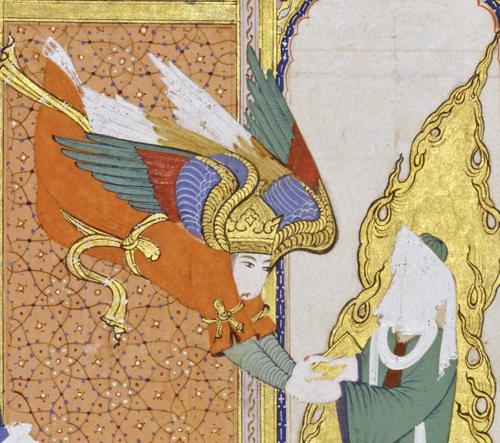
The Prophet Mohammed (PBUH) receiving the revelations of the Koran from the Angel Gabriel. Turkey? [Source]
Yep, he revealed the Quran to the Prophet, as I mentioned in an earlier post. Moving on:
Gabriel makes a famous appearance in the Hadith of Gabriel, where he questions Muhammad on the core tenets of Islam.
In Muslim tradition, Gabriel is considered one of the primary archangels. Exegesis narrates that Muhammad saw Gabriel in his full angelic splendor only twice, the first being when he received his first revelation. Muslims also revere Gabriel for a number of historical events predating the first revelation. Muslims believe that Gabriel was the angel who informed Zachariah of John’s birth as well as Mary of the future birth of Jesus and that Gabriel was one of three angels who had earlier informed Abraham of the birth of Isaac.
According to Islamic Tradition. The Angel Gabriel (Jibrayil in Arabic) was involved in many military campaigns of Muhammad helping, protecting and guiding him. The first was the Invasion of Dhi Amr. According to the Muslim scholar Sami Strauch, it is reported in Sahih Bukhari that it was raining, and Muhammad took his garments off and hung it on a tree to dry, while the enemy was watching, Ghwarath ibn al-Harith went to attack Muhammad. He threatened Muhammad with his sword and said “who will protect you from me on this day”. Then according to Muslim Scholars the Angel Gabriel came and thumped Ghawrath in the chest and forced him to drop his sword. Muhammad then picked up the sword and said “who will protect you from me”.
One really interesting thing is that Jibreel’s name is also used to refer to the Holy Spirit/al-Ruh al-Quddus. But there is emphatically no Trinity going on… it’s just another the the aspects of God…
On a final note, MOAR ANGELS.
Mohammed (far right) and the Archangel Gabriel standing in front of a giant angel. From the Miraj-name, Tabriz Iran (c. 1360-70) [Source]
Because they are awesome, in both senses of the word. Someday I’ll do entries on all the other named angels in the heavens. 🙂
“Lorien too dwelt far away, and his hall was great and dimly lit and had wide gardens. The place of his dwelling he called Murmuran, which Aule made of mists gathered beyond Arvalin upon the Shadowy Seas. ‘Twas set in the South by the feet of the Mountains of Valinor upon the confines of the realm,but its gardens wandered marvellously about, winding nigh to the feet of Silpion whose shining lit them strangely. They were full of labyrinths and mazes, for Palurien had given Lorien great wealth of yew trees and cedars, and of pines that exuded drowsy odours in the dusk; and these hung over deep pools. Glowworms crept about their borders and Varda had set stars within their depths for the pleasure of Lorien, but his sprites sang wonderfully in these gardens and the scent of nightflowers and the songs of sleepy nightingales filled them with great loveliness. There too grew the poppies glowing redly in the dusk, and those the Gods called fumellar the flowers of sleep — and Lorien used them much in his enchantments. Amidmost of those pleasances was set within a ring of shadowy cypress towering high that deep vat Silindrin. There it lay in a bed of pearls, and its surface unbroken was shot with silver flickerings, and the shadows of the trees lay on it, and the Mountains of Valinor could see their faces mirrored there. Lorien gazing upon it saw many visions of mystery pass across its face, and that he suffered never to be stirred from its sleep save when Silmo came noiselessly with a silver urn to draw a draught of its shimmering cools, and fared softly thence to water the roots of Silpion ere the tree of gold grew hot.”
— J.R.R. Tolkien, The Book of Lost Tales Part I: The Coming of the Valar and the Building of Valinor
My patented method of nipping an encroaching cold in the bud, known as “drink tea and boil yourself to death while wearing wool socks” may be crude and primitive, especially in warm weather, but it has never yet let me down.




 ephal ephalak idon hi-akallabeth
